SEO for AI and LLMs vs GEO: what actually changes

Table of Contents
People keep asking me: “Do we still need SEO, or is it all GEO now?”
Wrong question. SEO for AI is not a rebrand of classic SEO, and it is not the same as generative engine optimization. They share a site, not a scoreboard.
I am building RankMySEO in the open because this topic got too loud and too vague.
Classic SEO did not leave the building
Blue links still pay rent.
Google, Bing, and the long tail of search still send traffic when you have a clear query, a useful page, and a site that does not fight crawlers. Titles, meta, headings, internal links, Core Web Vitals, Search Console, backlinks that are not spam: that stack did not vanish because ChatGPT can summarize a blog post.
If your product page cannot rank for the boring commercial query, “AI SEO” will not rescue you. Classic SEO is still the system that puts a URL in a results list a human clicks.
When someone says geo vs seo like GEO replaced SEO, I push back. GEO sits on top of a site that already works. It does not replace crawlability, indexation, or a page that answers the question.
What people mean by SEO for AI and LLMs
“SEO for AI” and “SEO for LLM” usually mean: make the site easy for machines to read, trust, and reuse, without assuming a blue link is the only win.
In practice I mean three layers:
Clarity. One page, one job. Plain headings. Claims that match the body. Dates and ownership that are not buried. Models and agents get confused the same way juniors do: vague titles, thin paragraphs, and three CTAs fighting for attention.
Structure. Schema where it earns its keep. Clean HTML. Consistent entity names. Sitemaps that are not fiction. Optional agent-facing surfaces like llms.txt or markdown negotiation so a tool can fetch a readable slice. Those are readiness aids. They are not magic ranking levers, and I will not pretend they are.
Measurable loops. Keyword and rank tracking still matter. Audits still matter. If you cannot see what moved, you are guessing. SEO for AI without a dashboard is a vibe.
So seo for ai is not “write for robots only.” It is classic craft plus machine-readable clarity, plus optional surfaces so agents can work without scraping your marketing spaghetti.
What GEO is
GEO is generative engine optimization: get cited, quoted, or used inside generative answers.
The scoreboard is different. You care whether the model names you, links you, or paraphrases you in an answer box, not only whether position 3 on page one moved up. Brands, entities, clear sourcing, and pages that are easy to extract from help. Thin listicles that already lost classic SEO usually lose GEO too.
GEO does not mean abandon Search Console. It means you add another outcome: citation in AI answers. If your team only watches blue-link rank and ignores whether assistants mention you, you are half blind. If they only chase “get cited” and ignore crawl errors, they are cosplaying strategy.
The real difference
Three jobs. Do not mash them into one KPI.
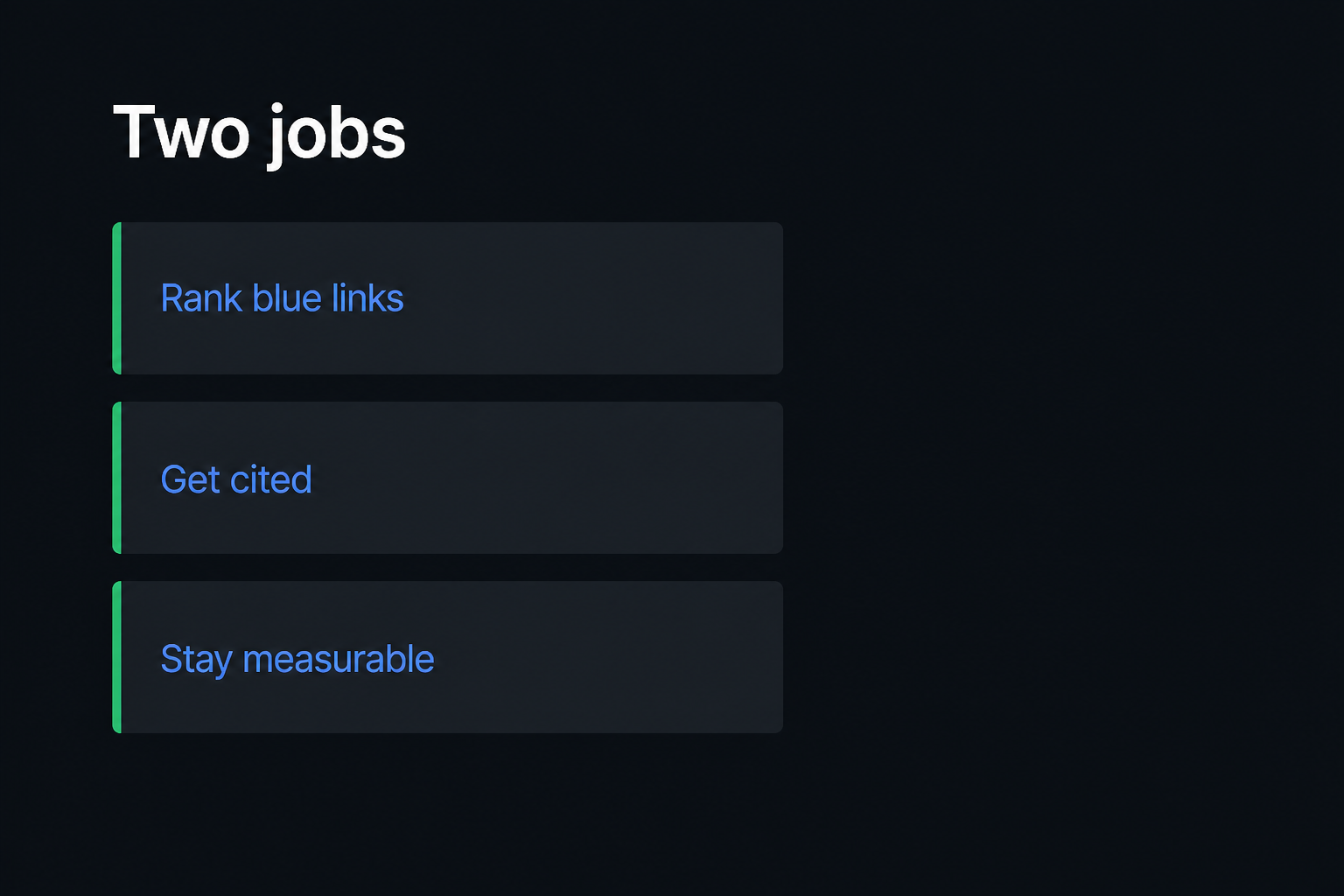
Classic SEO: rank and earn the click on a results list.
SEO for AI / LLMs: make the site clear and structured so machines (and humans) can use it, including optional agent surfaces.
GEO: get included in generative answers.
Same codebase. Different scoreboards. When a founder says “we need GEO,” I ask which number they will check next month. Rank for a query set? Citation screenshots? Both? If they cannot answer, they are buying a label, not a plan.
What I tell teams to do this month
Skip the rebrand deck. Do the boring work.
- Fix crawl and index basics. No orphan pages, no soft 404 theater, no blocked CSS that breaks rendering.
- Rewrite the money pages so each one answers one query with a real outline. Use the focus phrase where it belongs: title, H1, early body. For this topic that means saying seo for ai when you mean that job, not stuffing every synonym into one paragraph.
- Add or clean schema that matches visible content. Do not invent FAQ markup for questions the page does not answer.
- Keep Search Console and a rank tracker honest. Pick a small keyword set. Watch it weekly.
- If you want agent readiness, add sitemap hygiene and, if it fits the stack, something like
llms.txtor a markdown view. Treat it as documentation for tools, not a promised SERP boost. - For GEO, publish primary sources: clear author, clear product facts, pages worth citing. Thin affiliate roundups do not become citation magnets because you renamed the channel.
If you need a human to sit on the repo and install that loop, that is mentoring. If you need the product and content system built, that is the Build path.
What we are building with RankMySEO
I got tired of SEO talk that never touched the codebase. So we open-sourced RankMySEO under Apache-2.0.
It is a framework-agnostic JS/TS toolkit under the npm org @rankmyseo. Path is simple: npm i rankmyseo, then npx rankmyseo install.
You get keyword and rank tracking, audits, live scan, meta and schema helpers, dashboard widgets, an AI agent plus MCP that is approval-gated, and adapters for Hono, Express, Next, and Nitro.
Optional pieces cover sitemap, llms.txt, and markdown negotiation as agent-readiness. The README is honest: those are not evidenced SEO ranking levers. They are for tools that need a clean read.
Status today: milestones M0 through M5 are shipped. Offline paths are verified with a fixture datasource and a mock LLM. Live Google Search Console, PageSpeed Insights, and real LLM calls need your keys. Docs live in the wiki.
Next to the OSS toolkit, a hosted SaaS scaffold is in progress. No public SaaS URL to announce here, and no fake launch date. If you want the toolkit in your repo now, use the GitHub and npm path above.
That is how I connect the theory to shipping: track ranks, audit the site, keep agent tools behind approval, and stay honest about what moves rankings versus what helps machines read you.
Bottom line
Classic SEO still ranks blue links. SEO for AI is clarity, structure, and optional agent surfaces. GEO is citation inside generative answers. Different scoreboards, one site.
Do the crawl and content work first. Measure ranks. Then decide if citation is a real KPI for your brand. Use tools that keep you honest, not decks that rename the same checklist.
If you want help wiring that into a real Next.js or AI product stack, start at services or the Next.js build path. And if you want the OSS loop in your repo, RankMySEO is there: install, audit, track, keep the agent gated.
Need this built instead of read about?
Send me your project. I reply within 24 hours and tell you plainly whether I’m the right fit.
Send me your project

